Solar radiation collection with high concentration level, high optical efficiency and spectrum splitting.
The cost item in photovoltaic solar panels is the amount of photovoltaic material used. A concentrator reduces the amount of material used by concentrating the photons to fall on a much smaller area. If the geometric concentration level is 500, then the amount of material required is reduced by a factor of 500. The accuracy of tracking to keep the light focused on the solar cell increases with concentration level. Optical efficiency decreases as the concentration level increased.
 |
| Concentration with refraction |
 |
| Concentration with reflection |
Fresnel lens are commonly used to focus the photons. The cell is placed between the fresnel lens and the focus. If the area of the fresnel lens is A and the area of the cell is R, then the concentration level C is A/R. At concentration level C the cell is placed F/sqrt(C) distance from the focus, where F is the focal length. There are losses every time light is refracted or reflected. To simplify discussion these losses are not considered here.
 |
|
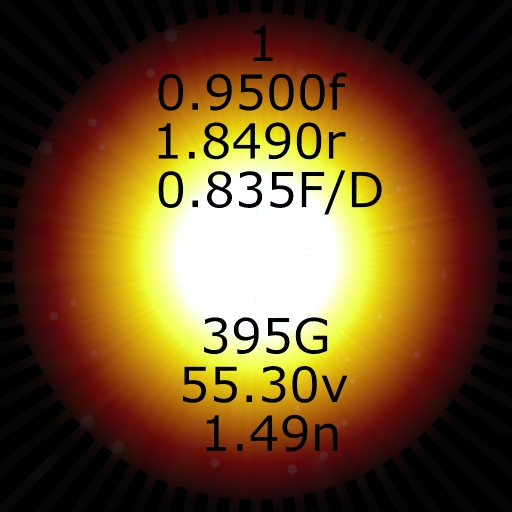
Ray-trace of 400x concentration at front focus with the cell radius 84% bigger. The cell has to be 237% bigger to capture 99% of the photons. The hot spot at the center is 1481x. The acrylic fresnel lens is 395mm x 395mm, with F/D of 0.835, 395 grooves, refraction index of 1.49 and Abbe number of 55.3 As photons converges to the focus point, it tends to cross itself, creating hot spots. Shorter wavelength (UV) photons are more refracted than longer wavelength (infra-red) photons causing the shorter wavelength photons to be more focused to the center and the longer wavelength photons are diffused away from the center. |
 |
|
Ray-trace of 400x concentration at back focus with the cell radius 41% bigger. The cell has to be 98% bigger to capture 99% of the photons. The high spot at the center is greater than 174,000x and approaches infinity as the spot gets smaller. At the back focus, the longer wavelength photons are concentrated at the center and the shorter wavelength photons are diffused over a large area. |
Various technologies (secondary optical elements, secondary flux modifiers, homogenizer, TIR-R Total Internal Refraction and Refraction) are used to make the concentrated light more uniform in intensity and color.
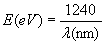
Heat is produced when the energy of the photon exceeds the band gap of the photovoltaic material. Solar cells lose efficiency for each oC rise in temperature. More electricity and less heat are produced if the band gap of the photovoltaic material and the energy of the photon are matched closely. The energy of the photon is a function its wavelength.
Multi junction devices are more efficient because they capture a larger portion of the solar spectrum by layering single junction cells of decreasing band gap. The top layer has the highest band gap. The theoretical efficiency (before optical and other losses) increases as the number of junctions is increased, reaching 86% for infinite number of junctions. A severe limitation of MJ cells is that the photocurrent produced by each layer must be matched because each layer is connected in series and the maximum current is limited by that produced by the weakest layer. Another limitation of MJ cells is that each layer must be optically transparent to allow the photons that it cannot use to pass to the layer below.
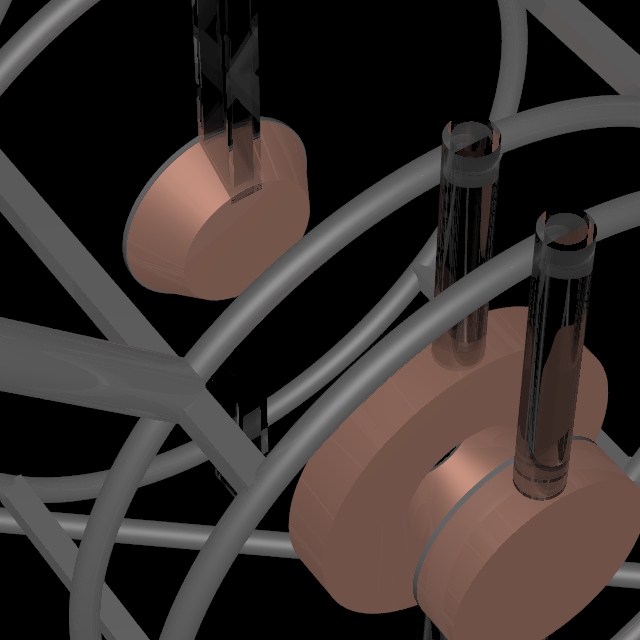
The methods described here aim to achieve high concentration level with minimal optical loss and more uniform intensity. These methods capture the concentrated shorter wavelength photons at the front and the concentrated longer wavelength photons at the back. This method uses fresnel lens to split the solar spectrum and capture more of the photons with three separate solar cells. The first cell at the front focus will capture more of the shorter wavelength photons and less of the longer wavelength photons. In the middle cell after the focus, the longer wavelength photons are now more focused to the center and the shorter wavelength photons to the edge. The middle cell has a hole in the center to pass the red and infra-red photons to the third cell behind it.
Silicon can be used as the photovoltaic material for all three cells. The light at the first solar cell will be quite uniform in colour, therefore 3J cells can be used at the front focus. For the second solar and third cells higher band gap materials are placed at the edge, using lower band gap materials as you move towards the center.
The heat load is now separated into three areas, with the third cell having the heaviest heat load because of the infra-red. Cooling is achieved by attaching liquid cooled copper heat sink to the back of the cells. The cells and the heat sink will need to be insulated from the environment to protect them and the environment. The heat sink for the front cell must be tapered to be smaller towards the focus. The heat sink for the middle cell is hollow, the hole is bigger towards the third cell. The front coolant tubes must present a flat surface to the front to reduce reflection losses. The concentrated infra-red at the third cell can be feed instead to a photovoltaic cavity converter or to drive high temperature chemical reactions.
Mirrors can be placed on the heat sink behind the first and second solar cell to reflect back light from the second and three solar cells to increase efficiency further.
To make use of convection the coolant will enter from the bottom of the heat sink and exit from the top. The coolant will pass through the front blue cell first, followed by the middle green cell, then the third infra-red/red cell. The electrical connections must be behind or inside the coolant tubes.
 |
 |
Light concentrated by reflectors also have the same problem with non-uniform intensity that is also solved by using the light at both the front and back focus. Reflective concentrators produces uniform color flux, which makes them more suitable for use with MJ (Multijunction) cells.
This method also applies to line focus fresnel lens instead of the point focus fresnel lens as described. The light pattern falling on the solar cells depends on the material of the fresnel lens, focal length, refraction index, Abbe number, number of grooves and the concentration level. Less grooves means less tip losses. This method applies to both imaging and non-imaging optics.
The light intensity and colour at each of the focus planes can be calculated using an appropriate algorithm. At each focal plane, the program can calculate the light intensity and colour as a function of the distance from the centre of the solar cell. This may be used to determine the width/radius for each slice forming the solar cell, so the energy falling on each slice is equal. The program may implement the algorithms described in Proceedings of SPIE - Volume 3781, 'Fresnel lens solar concentrator design based on geometric optics and blackbody radiation equation' by Michael D. Watson and Robert R. Jayroe, Jr., October 1999, pp. 85-93. This program can also calculate the concentration level for each focus plane so that the light intensity does not exceed a nominated intensity level at any of the slice. The program can also calculate the concentration level for a given solar cell radius at each focal plane.
For a particular lens, the optimum concentration level for the middle cell is when mostly infra-red and red light falls on the third cell. The optimum concentration level can be increased by using higher focal length, higher refraction index material for the fresnel lens or less color dispersive (higher Abbe number) material for the fresnel lens.
The ratio between electricity produced and the quality / temperature of the thermal energy produced can be actively controlled by regulating the flow rate of the coolant.
 |
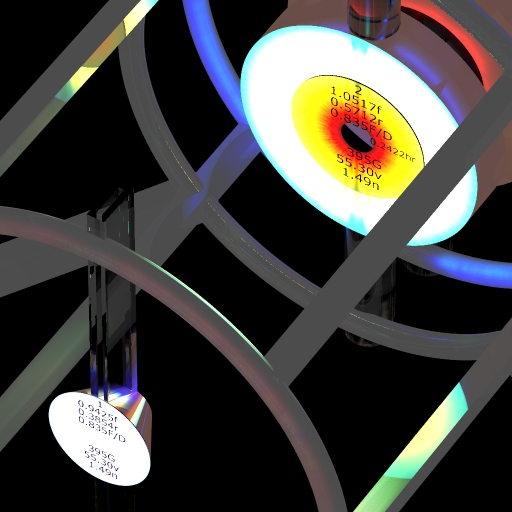
| Ray-trace using an acrylic Fresnel of 1000 x 1000 x 2 mm, a focal length of 1000 mm, a groove pitch of 0.2 mm, a refractive index of 1.49 and an Abbe number of 55.3. The spokes on the second cell show how much of the light (2.5%) misses that solar cell. |
 |
| Example of a three cells solar collector. Looking down, fresnel lens is at front and the solar cells at the back |
The program calculates the parameters so that about a third of the energy falls on the first cell. The two cells are divided into 35 slices. The width of both cells is 150mm.
The result of the calculations are as follows:
Total available energy 777 Watts
Acrylic Fresnel Lens width 1000 mm, focal length 1000mm (f/1), 2500 grooves
777W/m2 ASTM G-173-03 Direct Normal solar spectrum
Refraction index 1.492 at 589.2nm
Cauchy Equation n(nm) = 1.4779 + 5049.6 / nm ^ 2 - 6.9486e7 / nm ^ 4
Sun half angle 0.26657 degree
'Slice' is the slice number. 1 is the inner most slice.
'Radius' is the radius of the slice.
'Power' is the maximum energy that is available at that slice.
'Tot W' is the cumulative energy in Watts.
'Tot %' is the cumulative energy in percentage.
'QEff %' is the quantum efficiency.
'Ix' is the Light intensity for that slice. 1 means 1 sun concentration level.
'Ax' is the average concentration level for all cells. Area of Input/Area of all cells.
'Area' is the area of the slice.
'UV', 'Blue', 'Green', 'Red', 'NIR' (Near Infrared) and 'IR' (Infrared) is the percentage energy contribution of these wavelengths.
fresnelx w1000 g2500 l1000 r12 c11:75 c36:75 e97.5
 777.37W/m2 refractive index at 589.2nm(1.492) m(20), eff(97.500%)
  SunHalfAngle(0.26657o)
Total input energy 777 Watts
Acrylic Fresnel Lens Width 1000mm x 0.150mm, Area 1.00m2,
 Focal Length 1000mm (f/1.000), 2500 grooves
Slice Radius Power   Tot Tot QEff  Ix   Ax Area   UV BlueGreen  Red  NIR   IR
                                                 390  492  622  760 1110 4000
          mm     W     W   %   %            cm2    %    %    %    %    %    %
Cell 1 Concentration Level 4.3x, distance from lens 516.6mm, 0.52f,
 radius 272.7mm
   0     9.0  21.1    21   3  53  106  106    3    3   14   21   19   29   14
   1    15.6  21.1    42   5  53   53   71    5    3   14   21   19   29   14
   2    22.2  21.1    63   8  53   35   52    8    3   14   21   19   29   14
   3    28.8  21.1    84  11  53   26   42   11    3   14   21   19   29   14
   4    35.4  21.1   105  14  53   20   34   13    3   14   21   19   29   14
   5    42.0  21.1   126  16  53   17   29   16    3   14   21   19   29   14
   6    48.6  21.1   147  19  53   14   26   19    3   14   21   19   29   14
   7    55.2  21.1   168  22  53   13   23   22    3   14   21   19   29   14
   8    61.8  21.1   189  24  53   11   20   24    3   14   21   19   29   14
   9    68.4  21.1   211  27  53   10   18   27    3   14   21   19   29   14
  10    75.0  21.1   232  30  53    9   17   30    3   14   21   19   29   14

Cell 2 Concentration Level 38.5x, distance from lens 1161.3mm, 1.16f,
 radius 91.0mm, Center hole radius 75.0mm
  11    18.2  21.1   253  33  50   26   17   10    0    0    0   13   50   37
  12    20.6  21.1   274  35  56   91   19    3    0    0   15   24   40   21
  13    22.7  21.1   295  38  55   93   20    3    0    4   21   21   36   19
  14    24.7  21.1   316  41  54   90   21    3    0    9   20   20   34   18
  15    26.7  21.1   337  43  53   87   22    3    0   11   19   20   33   17
  16    28.6  21.1   358  46  53   83   23    3    2   10   18   19   33   17
  17    30.4  21.1   379  49  53   78   24    3    2   10   18   19   33   18
  18    32.3  21.1   400  51  53   75   25    4    2   10   18   19   33   18
  19    34.1  21.1   421  54  53   72   25    4    2   10   18   19   33   18
  20    35.9  21.1   442  57  53   69   26    4    2   10   18   19   33   19
  21    37.6  21.1   463  60  52   67   27    4    2   10   18   19   33   19
  22    39.4  21.1   484  62  52   65   28    4    2    9   17   19   33   20
  23    41.0  21.1   505  65  52   64   28    4    2    9   17   18   34   20
  24    42.7  21.1   526  68  52   63   29    4    2    9   17   18   34   21
  25    44.3  21.1   547  70  51   62   30    4    2    9   16   18   34   22
  26    45.8  21.1   568  73  50   63   30    4    1    8   15   17   34   24
  27    47.3  21.1   590  76  52   60   31    4    1    8   16   18   35   22
  28    49.0  21.1   611  79  56   55   31    5    2    9   17   19   39   15
  29    50.8  21.1   632  81  66   48   32    6    2   10   18   21   46    3
  30    52.8  21.1   653  84  64   40   32    7    2   11   21   25   41    0
  31    55.2  21.1   674  87  60   34   32    8    2   13   25   30   31    0
  32    58.1  21.1   695  89  56   27   32   10    3   15   30   37   14    0
  33    61.7  21.1   716  92  52   20   31   14    3   20   39   38    0    0
  34    66.7  21.1   737  95  48   13   30   20    4   27   54   14    0    0
  35    75.0  21.1   758  98  44    7   28   37    7   43   49    0    0    0
  36   116.1  19.4   777 100  38    1   17  247   25   68    6    0    0    0
 |
 |
Another example using a 4 x 4 array of 1500mm x 1500mm Fresnel lenses of four different types to construct a 36m2 Fresnel lens system with a focal length of 5012mm. The solar cell 1 consist of 48 circular slices of silicon. The 48 slices are connected in series from the centre to the edge to produce 28.8 volts. Increased voltage (or lower current) may be generated by increasing the number of slices. The width of each slice is made proportional to the light energy expected at its distance from the centre, so that the current produced by each strip is the same. Slice 35 and 36 are not used because the light intensity is too low and too much material will be required to collect it.
All the solar cells are placed on an aluminium oxide ceramic base that is bonded to a copper heat sink. The second and third cell will be constructed similarly. Such a cell can be constructed on a single 150/200 mm wafer with current microelectronic batch fabrication processes, such techniques are described in US patent 3,994,012 to Raymond Warner, Jr.
The results of a simulation of the light intensity and distribution for 36 on three cells.
fresnelx w6000 g6000 l5012 r13 R25 c12:75 c24:100 c34:100 e99
 777.37W/m2 refractive index at 589.2nm(1.492) m(20),
  eff(99.000%) SunHalfAngle(0.26657o)
Total input energy 27985 Watts
Acrylic Fresnel Lens Width 6000mm x 0.405mm, Area 36.00m2,
 Focal Length 5012mm (f/0.835), 6000 grooves
Slice Radius Power   Tot Tot QEff    Ix   Ax   Area   UV BlueGreen  Red  NIR   IR
                                                   390  492  622  760 1110 4000
          mm     W     W   %   %                cm2    %    %    %    %    %    %
Cell 1 Concentration Level 343.8x, distance from lens 4741.7mm, 0.95f,
 radius 182.6mm
   0    26.1 769.6   770   3  49    464    464   21   16   19   20   15   21    9
   1    30.4 769.6  1539   6  51   1295    683    8   10   20   21   17   22   10
   2    34.7 769.6  2309   8  50   1128    787    9   11   20   21   16   22   10
   3    38.9 769.6  3078  11  50   1009    833   10   12   20   21   16   21    9
   4    43.1 769.7  3848  14  50    914    848   11   14   20   20   16   21    9
   5    47.3 769.6  4618  17  50    823    843   12   13   20   20   16   21    9
   6    51.6 769.6  5387  19  50    741    827   13   11   22   20   16   21    9
   7    56.1 769.6  6157  22  50    659    802   15    8   24   21   16   22   10
   8    60.6 769.6  6927  25  51    599    773   17    3   28   21   16   22   10
   9    65.2 769.6  7696  28  51    539    740   18    0   29   22   17   22   10
  10    70.0 769.6  8466  30  51    486    707   20    0   28   22   17   23   10
  11    75.0 769.7  9235  33  52    438    672   23    0   26   23   18   24   10

Cell 3 Concentration Level 162.3x, distance from lens 5405.4mm, 1.08f,
 radius 265.7mm
  12    23.9 769.6 10005  36  37    553    661   18    0    0    0    0   43   57
  13    31.7 769.6 10775  39  52    720    665   14    0    0    0    9   56   36
  14    37.9 769.6 11544  41  50    729    669   14    0    0    0   19   47   35
  15    42.5 769.6 12314  44  42    858    678   12    0    0    1   18   36   45
  16    45.9 769.6 13084  47  33   1065    693    9    0    0    3   13   29   56
  17    49.6 769.6 13853  50  45    886    702   11    0    0    5   15   40   40
  18    52.7 769.6 14623  52  44    979    712   10    0    0    4   13   40   44
  19    56.8 769.6 15392  55  61    711    712   14    0    0    0   15   61   24
  20    61.1 769.6 16162  58  84    614    707   16    0    0    0    8   90    1
  21    67.0 769.6 16932  61  84    421    686   24    0    0    0    2   98    0
  22    75.7 769.6 17701  63  80    255    639   39    0    0    0    0  100    0
  23   100.0 769.6 18471  66  74     74    484  134    0    0    0    7   93    0

Cell 2 Concentration Level 365.3x, distance from lens 5274.2mm, 1.05f,
 radius 177.1mm, Center hole radius 25.5mm
  24    28.9 769.6 19241  69  62   1700    475    6    0    0   10   35   46    9
  25    32.8 769.6 20010  72  59   1305    487    8    0    0   14   52   25   10
  26    37.0 769.6 20780  74  56   1061    497    9    0    0   18   71    1   10
  27    41.9 769.6 21549  77  54    821    504   12    0    0   24   66    0   10
  28    47.4 769.6 22319  80  53    642    508   15    0    0   30   61    0    9
  29    53.8 769.6 23089  83  53    483    507   20    0    2   38   55    0    6
  30    61.6 769.6 23858  85  52    353    500   28    0    5   49   42    0    4
  31    71.3 769.6 24628  88  52    244    484   41    0   10   76   13    0    1
  32    83.6 769.6 25398  91  50    165    457   60    0   17   83    0    0    0
  33   100.0 769.6 26167  94  47    105    416   95    0   26   74    0    0    0
  34   124.4 769.6 26937  96  45     58    353  172    0   42   58    0    0    0
  35   173.1 769.6 27706  99  42     22    248  455    0   80   20    0    0    0
  36   253.3 278.7 27985 100  40      3    143 1074    0  100    0    0    0    0
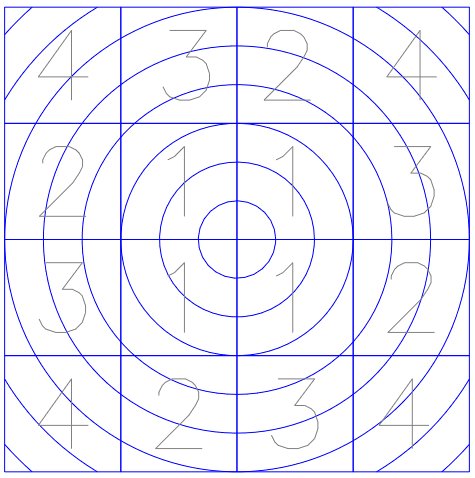 | |
| 4 x 4 array of fresnel lens constructed from 4 different fresnel lens. | |
| Front Cell radius 75mm | |
|---|---|
| Back Cell radius 75mm | |
| Single HMJ Cell radius 152mm | |
| HMJ (Horizontal Multijunction) cell with total of 100 slices producing 60 volts. No front surface grid, front or back contact, bus bar or bypass diode is required. High voltage/low current. Wafer size solar cell (75mm to 450mm diameter). Run 'fresnelx w1000 s105 r50 c50:75 c99:75' to show simulation for front and back cells. Run 'fresnelx w1000 s105 c99:150' for single cell. | |
Initial application will be in solar farms in regions with high direct insolation to efficiently supply loads up to 7000km away with underground high voltage DC (HVDC) transmission lines. With this method, the major cost item is shifted from the solar cells to the fresnel lens. The cost of the fresnel lens can be reduce by making them as thin as possible.
The land below this type of solar concentrator can still be used, because the diffused background light cannot be focused. Example of such land are parks, car parks, over roads (when we stop using pollution causing cars), cycle ways, schools, shops, residential and degraded land. This method will very efficiently in extracting the direct UV and Infra-red radiation. Concentrated solar power can be very dangerous, take care. Wind load will become a problem as the size of the fresnel lens gets bigger and higher.
Philip Wong BSc BE(UNSW)
Phone/fax: 61 2 9805 0356
Sydney, Australia
ioserver@ioserver.com
Fresnelx Calculates intensity and colour distribution of solar radiation falling on up to three surfaces. Run "fresnelx x" to see available commands.
Concentrated Solar Thermal Power with Point Focus Fresnel lens and reflector
Bifacial concentration on VMJ (Vertical Multijunction) solar cells
Spectrum splitting concentration on to three solar cells
Lens
Fresnel Lens Manufacturer. fresneloptic.com
Fresnel Lens Manufacturer. ntkj.co.jp 2.9m x 5m lens
Fresnel Lens Distributor. 3dlens.com
Cells
Spectrolab Terrestrial Concentrator cells
Indium Gallium Nitride Solar Cells
Tracking
Precise Tracking. Precision Solar Technologies
References
Optical Design software. optenso.de
Persistence of Vision Raytracer
Reference Solar Spectral Irradiance: ASTM G-173
|
Last updated: Mon, 25 Jan 2021 08:28:43 GMT |